
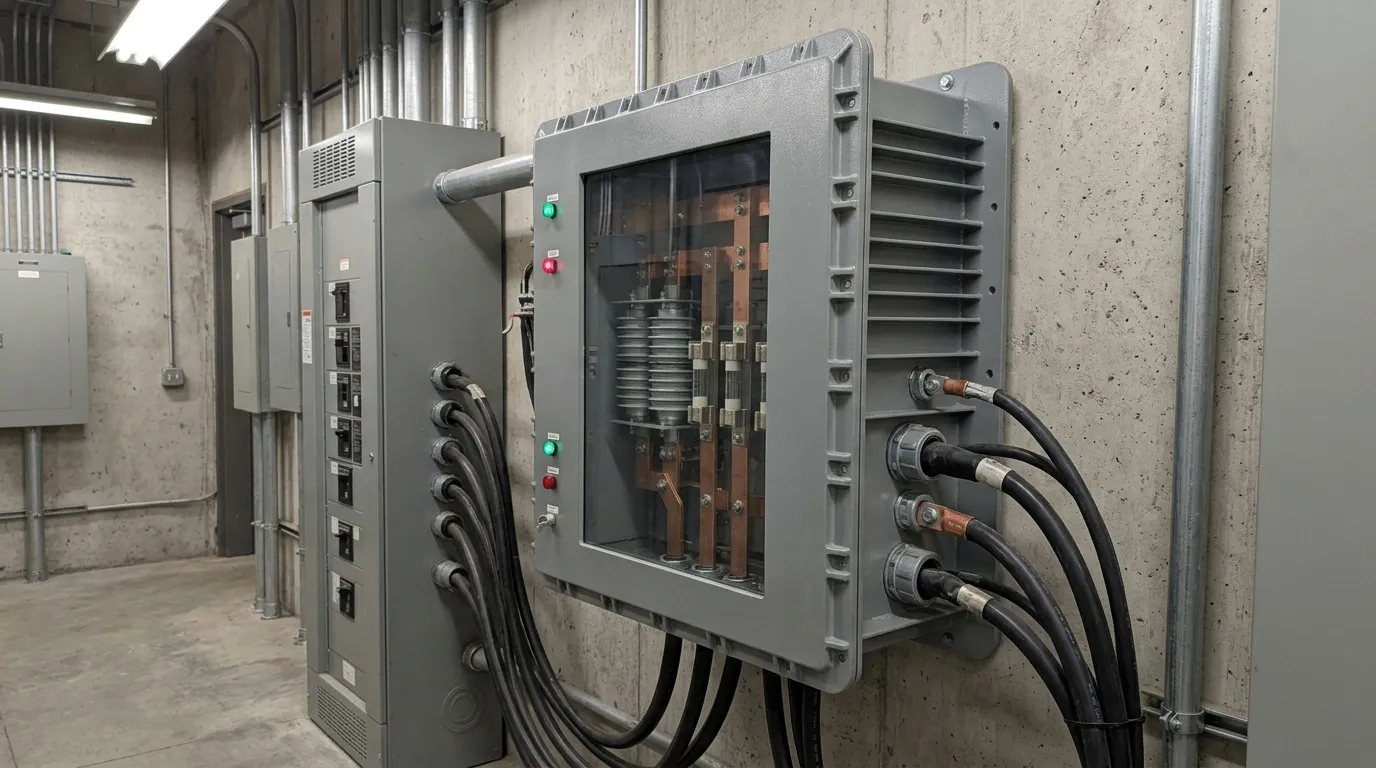
Modern manufacturing facilities rely heavily on delicate automated machinery and complex electrical networks to maintain continuous operations. Implementing robust industrial surge protection safeguards these critical assets against destructive voltage spikes that threaten system stability daily.
Unmanaged electrical transients can instantly ruin expensive machinery, trigger costly operational downtime, and create severe hazards for facility personnel. Establishing a comprehensive protection strategy ensures uninterrupted productivity while preserving the structural integrity of your electrical infrastructure.
Key Takeaways:
- Industrial surge protection diverts harmful transient voltages into the grounding system to shield sensitive machinery.
- A multi-stage SPD setup systematically reduces energy from service entrances down to sensitive control panels.
- Roughly 80% of transient surges occur internally due to routine motor switching and heavy machinery operations.
- Protecting signal and data lines alongside power feeds prevents data corruption and automation network failure.
- Implementing robust surge suppression prevents costly operational downtime and extends the operational lifespan of facility assets.
What is Industrial Surge Protection?
Understanding the foundation of industrial surge protection is essential for modern facility managers seeking long-term operational security. This system forms the frontline defense against unpredictable electrical disturbances.
Industrial surge protection relies on heavy-duty Surge Protection Devices (SPDs) to manage harmful transient voltages. These specialized units constantly monitor lines and automatically divert high-voltage spikes safely into the grounding system.
By channeling excess energy away from sensitive equipment, surge arresters shield expensive automated machinery from catastrophic failure. This continuous voltage clamping prevents insulation breakdown and secures overall facility infrastructure.
Read Also: Power Distribution Unit: Avoid Power Distribution Risks!
The Three-Stage Principle of Industrial SPDs
Deploying a multi-stage defense strategy ensures complete electrical isolation across every level of your facility’s power distribution network. Each zone requires specific suppression capabilities.
Stage 1: Type 1 SPDs for Main Entrance Lightning Protection
Type 1 SPDs serve as the primary defensive barrier at the main service entrance where utility power enters the facility. These heavy-duty lightning current arresters are specifically engineered to handle massive energy surges caused by direct atmospheric strikes or severe grid shifts.
Installing these robust entrance arresters ensures that high-energy currents are safely clamped before spreading through internal distribution systems. This initial mitigation step protects primary transformers and heavy-duty switchgear from suffering catastrophic thermal damage.
Stage 2: Type 2 SPDs for Sub-Distribution Boards
Downstream Type 2 SPDs are installed within intermediate sub-distribution boards to suppress residual voltage spikes that pass Stage 1. These secondary units absorb leftover energy and effectively clamp internal switching transients generated within local electrical sub-panels.
By maintaining low residual voltage, these mid-level arresters prevent cumulative insulation stress on secondary feeder circuits. Their fast response time stabilizes internal power quality before electrical noise reaches sensitive localized machinery.
Stage 3: Type 3 SPDs for Terminal Equipment & Control Panels
Positioned directly at sensitive terminal equipment, Type 3 SPDs offer fine-grained protection for delicate microprocessors and control interfaces. These compact devices handle low-level residual transients right at the point of load, neutralizing micro-spikes instantly.
Protecting localized hardware like programmable logic controllers (PLCs) requires ultra-fast response times and precise voltage clamping capabilities. Utilizing dedicated point-of-use arresters ensures maximum operational uptime for critical automated assembly lines.
Sources of Transient Surges in Industrial Environments
Identifying the origin of voltage spikes allows engineers to design tailored protection schemes for complex industrial environments. Electrical threats stem from both external grid events and internal machine operations.
1. External Surges: Lightning & Power Grid Fluctuation
External threats primarily originate from direct lightning strikes, severe weather events, or major utility grid switching operations. Although these high-energy occurrences happen less frequently, an unprotected strike can instantly destroy critical service entrance equipment.
Utility switching surges and nearby grid disruptions can introduce massive high-voltage waves into facility electrical lines. Without proper primary arresters, these sudden voltage swells bypass standard circuit breakers and cause severe facility-wide damage.
2. Internal Surges: Heavy Machinery & Motor Switching
Approximately 80% of transient surges are generated internally through routine operations like heavy motor switching and inductive load stepping. Variable frequency drives and large capacitive banks frequently discharge quick voltage spikes directly into internal distribution lines.
These high-frequency internal transients continuously degrade delicate microchip insulation over time, leading to unexpected secondary equipment failure. Implementing localized suppression neutralizes internal switching noise before it damages adjacent automated production machinery.
Key Benefits of Implementing Industrial Surge Protection
Investing in comprehensive voltage suppression delivers measurable financial returns while securing critical operational assets. Facility managers gain significant advantages in safety, equipment reliability, and overall productivity.
1. Preventing Costly Operational Downtime
Unplanned operational halts caused by blown control boards can instantly halt production and cause thousands of dollars in lost yield. Utilizing dedicated surge suppressors keeps automated robotics, SCADA networks, and PLCs running reliably without sudden disruptions.
Preventing electronic damage eliminates emergency maintenance costs and avoids lengthy manufacturing delays during peak operational shifts. Continuous power stability protects critical process lines from experiencing costly hardware resets or corrupt data cycles.
2. Enhancing Workplace Safety & Equipment Longevity
High-voltage spikes present severe electrical fire risks and accelerate the physical degradation of complex machinery components. Proper surge mitigation prevents destructive arc flashes, protects personnel, and preserves expensive manufacturing assets for years.
Shielding delicate control electronics against continuous micro-transients significantly extends the overall operational lifespan of heavy factory equipment. Reduced component stress translates into lower capital expenditure and improved long-term facility efficiency.
Essential Considerations for Industrial SPD Installation
Selecting and deploying suppressors requires strict adherence to technical standards and specialized mounting methods. Proper structural integration ensures optimal surge diversion performance under extreme operational conditions.
1. DIN Rail Mounting in Control Panels
Industrial suppressors feature heavy-duty enclosures designed specifically for secure DIN rail mounting inside standard electrical control panels. Unlike consumer plug-in strips, these commercial modular units provide direct, low-impedance connections to internal grounding buses.
Compact modular designs allow electrical engineers to easily replace worn protection modules without unwiring main circuit connections. This industrial panel layout simplifies routine maintenance while ensuring maximum mechanical stability during high-energy discharge events.
2. Protecting Signal, Data, and Automation Networks
Non-power communication lines like Ethernet, RS232, and PLC data buses remain highly vulnerable to destructive transient currents. Surge protection must extend beyond power feeds to shield sensitive automated communication channels against data corruption.
Electromagnetic interference and induced loop voltages can easily ruin unshielded data transceivers and disrupt industrial automation networks. Installing specialized low-voltage data arresters secures signal integrity and maintains seamless system-wide telemetry communication.
References:
- Anand, A., & IEEE Power & Energy Society. (2020). Analysis of internal switching transients and surge protection performance in automated industrial power networks. IEEE Transactions on Industry Applications, 56(4), 3412–3420. https://doi.org/10.1109/TIA.2020.2985412.
- Guo, Y., Zhang, X., & Liu, Z. (2022). Insulation degradation mechanisms of microcontrollers under repeated fast transient voltage surges. IEEE Transactions on Dielectrics and Electrical Insulation, 29(2), 589–597. https://doi.org/10.1109/TDEI.2022.3151211.
- Hasse, P. (2018). Overvoltage protection of low-voltage systems (3rd ed.). Institution of Engineering and Technology (IET). https://doi.org/10.1049/PBPO033E.
- International Electrotechnical Commission. (2020). IEC 61643-11:2011/AMD1:2020 – Low-voltage surge protective devices – Part 11: Surge protective devices connected to low-voltage power systems – Requirements and test methods. IEC Webstore. https://webstore.iec.ch/publication/67215.