
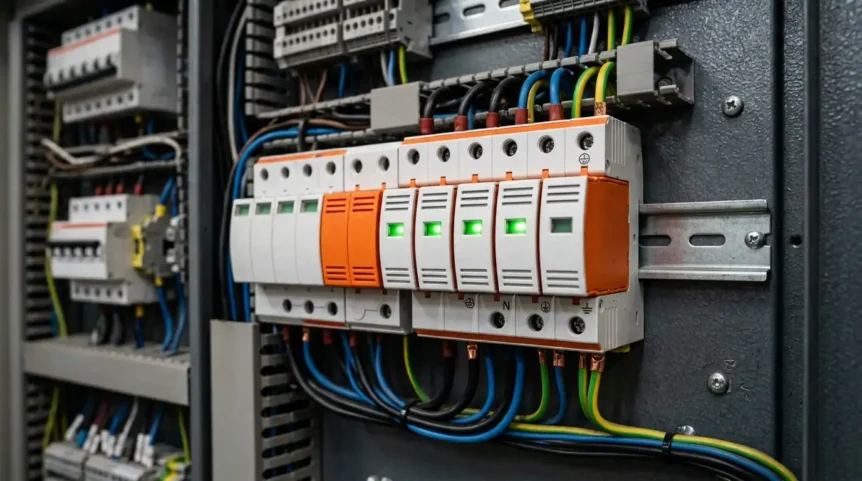
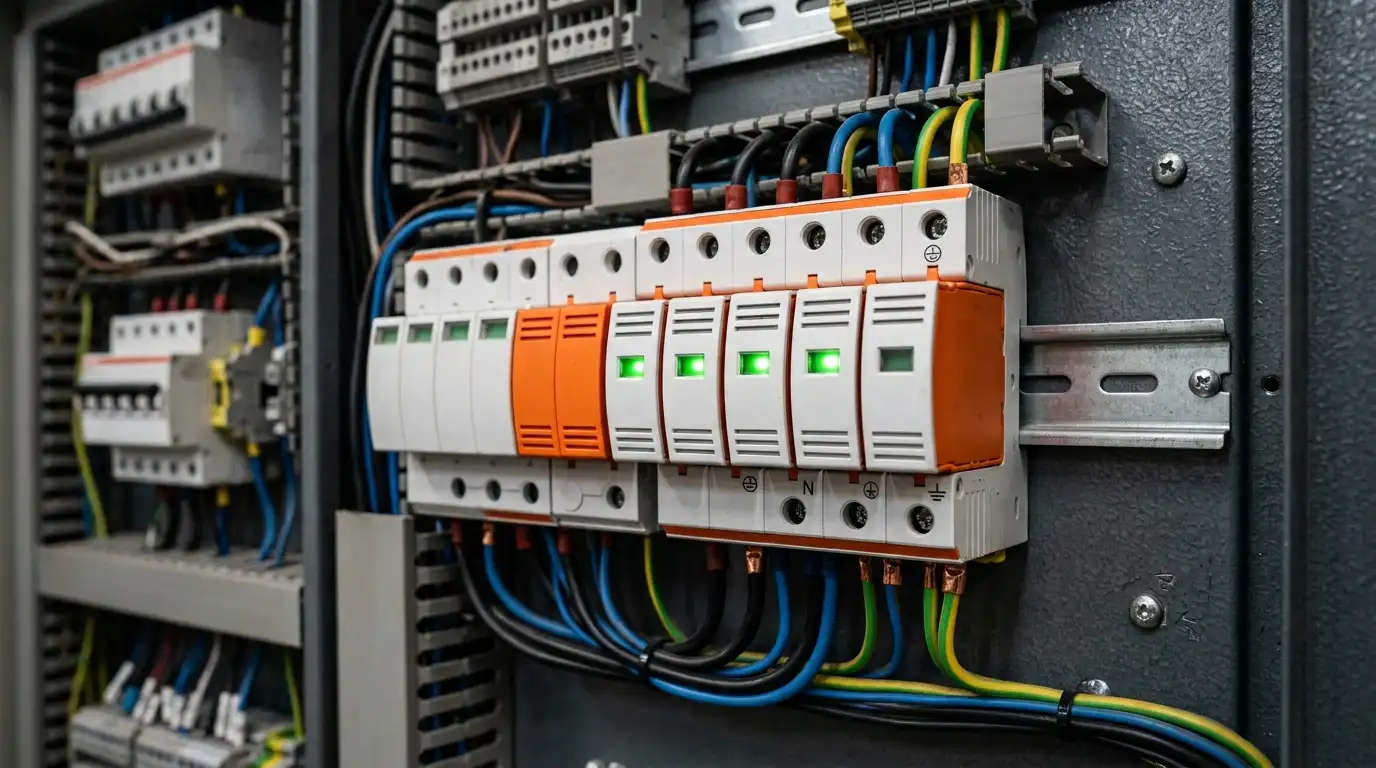
Modern electrical networks face continuous threats from unpredictable voltage spikes and electrical anomalies. Investing in reliable surge protective devices ensures long-term safety for critical electronics and infrastructure worldwide.
Without proper defense systems, sudden power fluctuations can ruin delicate components within milliseconds. Implementing dedicated surge protection remains the most effective strategy to prevent hardware damage and costly downtime.
Key Takeaways:
- Surge protective devices protect sensitive electronics by diverting dangerous voltage spikes safely into the grounding system.
- SPDs switch from high to low impedance in nanoseconds to absorb transient surges without interrupting normal power.
- Selecting the right SPD requires evaluating key technical parameters like MCOV, discharge current ratings, and clamping voltage.
- Comprehensive facility defense relies on layering Type 1, Type 2, and Type 3 SPDs across distribution panels.
What is a Surge Protective Device (SPD)?
Understanding basic electrical safeguards is essential for maintaining smooth commercial and residential power infrastructure. A surge protective device acts as a vital security shield for sensitive electronics against destructive power fluctuations.
These components operate continuously to detect dangerous transient voltages before they harm connected devices. By immediately diverting excessive electrical energy into a safe grounding system, they maintain operational stability across all circuits.
Read Also: Industrial Surge Protection: Stop Transient Voltage Spikes
Key Factors to Consider When Choosing an Surge Protective Device
Selecting the right surge protective device requires evaluating critical technical specifications to guarantee comprehensive network safety. Engineers and facility managers must match unit parameters directly with local grid conditions to prevent equipment breakdown.
1. Maximum Continuous Operating Voltage (MCOV)
The Maximum Continuous Operating Voltage indicates the peak power level an arrester handles continuously without activating. Choosing an appropriate threshold prevents constant thermal stress and avoids premature component degradation during standard grid operation.
If line power exceeds this rated tolerance, internal components risk overheating and rapid operational failure. Correctly sizing this parameter ensures reliable performance while keeping sensitive equipment protected against subtle power fluctuations.
2. Discharge Current Ratings (In and Imax)
The nominal discharge current measures an arrester’s ability to survive repetitive transient surges without sustaining internal damage. Meanwhile, the maximum discharge current defines the peak single-event energy load a unit can safely divert to ground.
Evaluating these dual capacity metrics allows engineers to select robust components tailored for high-risk industrial environments. Proper sizing guarantees long-term durability during severe weather events or heavy mechanical load switching cycles.
3. Voltage Protection Rating (VPR) and Clamping Voltage
The voltage protection rating determines the maximum residual voltage that reaches connected hardware during a sudden surge. A lower clamping threshold ensures superior protection for sensitive microelectronics by restricting dangerous voltage let-through levels.
Balancing this protective limit against system operating parameters prevents unnecessary stress on internal component insulation. Specifying precise clamping thresholds keeps sensitive digital assets safe from cumulative voltage damage over time.
How Does a Surge Protective Device Work?
A surge protective device functions like an automated pressure relief valve within an electrical network. It monitors power conditions in real time to secure all downstream machinery against unexpected voltage spikes.
1. Normal Operating Condition
During standard electrical operations, a surge protective device maintains an extremely high electrical impedance state. This non-conductive state ensures that regular alternating current flows directly to connected loads without interference.
Under these peaceful grid conditions, the surge protective device draws virtually zero current from the main line. It remains silently on standby, constantly monitoring the line for sudden changes in electrical potential.
2. Response During a Voltage Spike
When a sudden transient overvoltage occurs, the device instantly shifts its internal state to low impedance. This rapid transition happens within nanoseconds to intercept destructive energy spikes caused by lightning strikes or grid switching.
By reducing its internal resistance almost instantaneously, the unit provides a fast path for incoming high energy. This swift response isolates delicate microchips from experiencing severe voltage strain during sudden power spikes.
3. Current Diversion and Recovery
Once activated, the device safely redirects the high-energy surge away from load equipment directly into the grounding electrode. This process effectively clamps the excessive residual voltage down to safe, manageable thresholds instantly.
After the transient threat passes, the unit automatically restores its original high-impedance state without manual reset. This seamless recovery capability ensures continuous protection for ongoing operations without interrupting the primary electrical service.
Types of Surge Protective Devices
Choosing the right surge protective device depends on where it sits within an electrical distribution layout. Matching specific device ratings to appropriate installation points creates a robust defense against all power surges.
Type 1 SPD: Primary Service Entrance Protection
Installed directly at the main entrance, a Type 1 device defends against massive external threats like direct lightning currents. These heavy-duty arresters handle intense energy impulses right where main power utility cables enter a facility.
By absorbing peak energy loads at the primary boundary, they shield the entire building layout from catastrophic damage. Facilities rely on these robust units to maintain fundamental safety before power splits into secondary distribution circuits.
Type 2 SPD: Internal Installation & Sub-Panel Protection
Positioned at sub-distribution boards, Type 2 units target residual energy and internally generated transient surges. They suppress dangerous voltage fluctuations originating from heavy motor switching or nearby secondary lightning discharges within the network.
These versatile devices ensure that individual branch circuits remain balanced during daily industrial or commercial power demands. Integrating Type 2 protection keeps sensitive machinery safe from internal electrical noise and frequent switching transients.
Type 3 SPD: Point-of-Use Equipment Protection
Type 3 units provide local protection directly adjacent to sensitive end-user hardware like computers and medical monitors. These compact devices offer fine-tuned clamping capability to eliminate small leftover power fluctuations near sensitive components.
Working alongside primary breakers, they deliver the final layer of defense for high-value office or household technology. Utilizing point-of-use protection guarantees that localized equipment stays fully guarded against any subtle line noise.
References
- Anand, A., & IEEE Power & Energy Society. (2020). Analysis of internal switching transients and surge protection performance in automated industrial power networks. IEEE Transactions on Industry Applications, 56(4), 3412–3420. https://doi.org/10.1109/TIA.2020.2985412
- Guo, Y., Zhang, X., & Liu, Z. (2022). Insulation degradation mechanisms of microcontrollers under repeated fast transient voltage surges. IEEE Transactions on Dielectrics and Electrical Insulation, 29(2), 589–597. https://doi.org/10.1109/TDEI.2022.3151211
- International Electrotechnical Commission. (2020). IEC 61643-11:2011/AMD1:2020 – Low-voltage surge protective devices – Part 11: Surge protective devices connected to low-voltage power systems – Requirements and test methods. IEC Webstore. https://webstore.iec.ch/publication/67215
- Standler, R. B. (2021). Protection of electronic circuits from overvoltages. Dover Publications / IEEE Press. https://doi.org/10.1109/9780470545225