

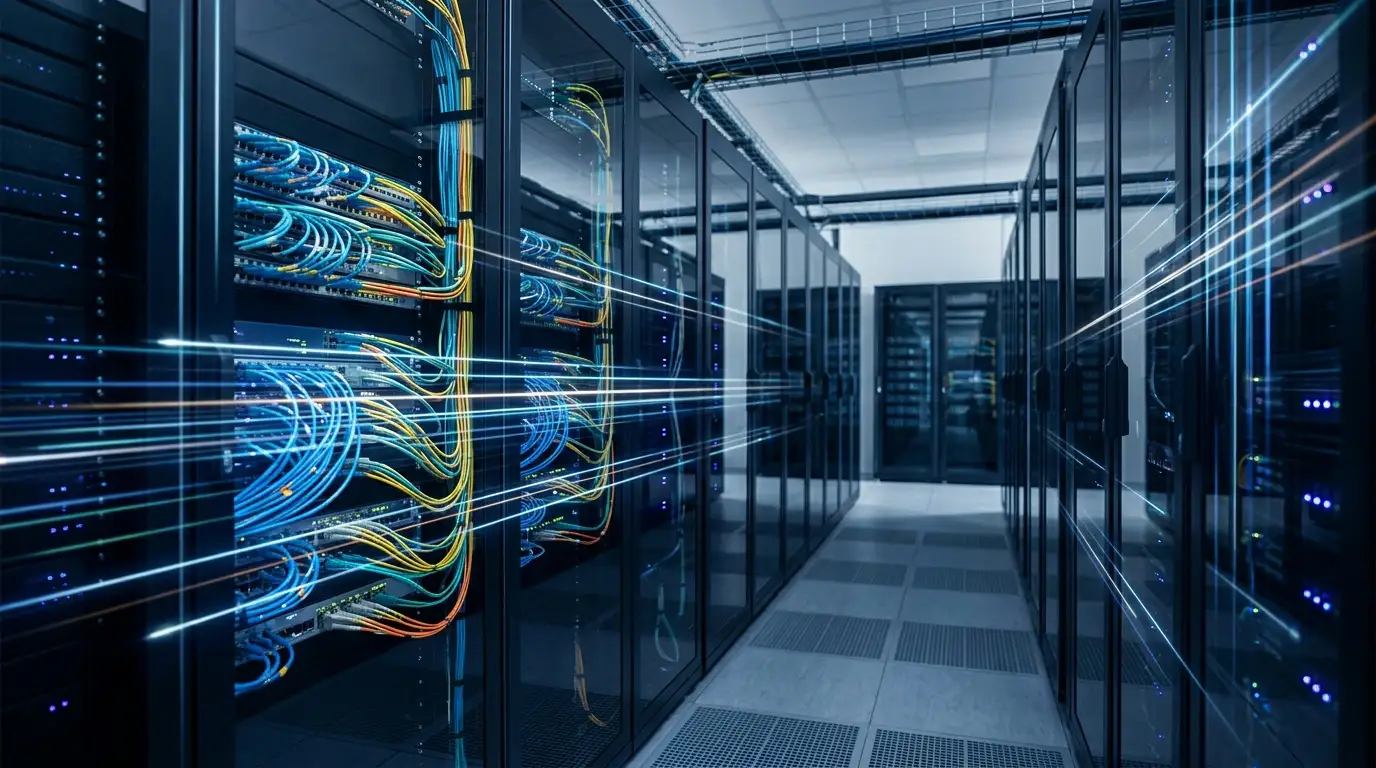
Modern enterprises rely on robust data center connectivity solutions to maintain seamless communication across globally distributed digital infrastructures. These advanced solutions enable organizations to route massive datasets rapidly while ensuring minimal network latency and maximum operational uptime.
As businesses continue to scale their cloud infrastructure and compute workloads, choosing the right physical and virtual connections becomes critical. High-performance networking forms the fundamental backbone for digital transformation, artificial intelligence processing, and secure enterprise applications.
Key Takeaways:
- Data center connectivity solutions link internal servers, external cloud platforms, and remote facilities for continuous data access.
- Core technologies like DWDM fiber optics, dark fiber, and cross connects deliver high bandwidth, low latency, and security.
- Software-defined networking and Spine-Leaf architectures eliminate traffic bottlenecks, supporting AI and high-performance workloads across hybrid cloud environments.
What are Data Center Connectivity Solutions?
Understanding data center connectivity solutions begins with examining how modern facilities transmit digital signals across local and global networks. These systems integrate hardware cabling, optical components, and intelligent software to establish continuous, reliable data pathways.
At their core, these networking solutions link facility infrastructure directly with end-user devices, external cloud service providers, and remote backup facilities. They guarantee high-throughput transmissions, stringent data security, and low packet loss for mission-critical enterprise operations.
Read Also: Cloud Managed Data Center Services: Maximize IT Uptime
Key Categories of Data Center Connectivity Solutions
Categorizing data center connectivity solutions helps IT managers select the right network pathways based on location and performance needs. These architectures span internal facility links, facility-to-facility trunks, and external connections to broad public or private networks.
1. Data Center Interconnect (DCI)
Data Center Interconnect (DCI) links distinct facilities across different geographic regions using high-bandwidth optical transport networks. This inter-facility linkage allows organizations to share workloads dynamically while preventing single-point-of-failure network outages.
Deploying DCI infrastructure is critical for real-time data replication, automated load balancing, and rapid disaster recovery (DR) routines. It ensures continuous data availability even during unexpected regional disruptions or hardware failures.
2. Internal Connectivity (Chip-to-Chip / Rack-to-Rack)
Internal connectivity manages high-density network traffic within a single facility between individual servers, storage systems, and switches. This localized wiring uses direct attach copper (DAC) cables or short-reach optical transceivers inside equipment racks.
Optimizing intra-building rack-to-rack links reduces localized bottlenecks and accelerates data exchange between computing nodes. Highly efficient internal wiring ensures that internal hardware components process intensive computational workloads without network stalling.
3. External Connectivity (Data Center to Cloud / User)
External connectivity bridges the data center to public internet channels, enterprise WAN networks, and major third-party cloud platforms. These external gateways allow remote users and corporate offices to access central databases reliably and securely.
By utilizing direct cloud links or enterprise MPLS circuits, organizations bypass congested public internet routes for predictable transmission speeds. This external layer protects data privacy while maintaining steady bandwidth for remote employees.
Essential Data Center Connectivity Technologies
Modern network engineering relies on specialized transmission hardware, dedicated optical lines, and programmable software layers. Evaluating these core technologies ensures organizations deploy scalable, high-speed architectures tailored to their precise operational demands.
1. Fiber Optics & DWDM Technology
Fiber optic cables serve as the core physical backbone for medium and long-distance connectivity due to superior signal integrity. Using Dense Wavelength Division Multiplexing (DWDM), network engineers multiplex multiple optical wavelengths over a single glass fiber strand.
This optical aggregation dramatically expands total network bandwidth without requiring expensive new cable deployments in underground conduits. DWDM delivers multi-terabit capacity, making it ideal for high-volume enterprise data pipelines.
2. Direct Connect & Cross Connect
A physical cross connect provides a dedicated, point-to-point cable connection inside a shared colocation facility. This direct link pairs enterprise hardware straight to ISPs or cloud edges without traversing the open internet.
By bypassing public network hops, direct connection models drastically reduce network latency while boosting baseline data privacy. Organizations benefit from consistent transmission speeds and minimized vulnerability to external internet threats.
3. Dark Fiber Infrastructure
Dark fiber refers to pre-laid optical fiber lines leased directly from telecom providers without active lighting equipment attached. Enterprise clients install their own optical transceivers, gaining full control over capacity, framing protocols, and security.
This unlit infrastructure delivers virtually unlimited bandwidth scalability and unmatched data protection for highly regulated business sectors. Enterprises can scale throughput on demand simply by upgrading their own endpoint hardware.
4. Software-Defined Networks (SD-WAN & SDN)
Software-Defined Networking (SDN) decouples network control logic from physical routing hardware to automate traffic management. Similarly, SD-WAN technology dynamically routes branch office traffic across optimal paths based on live network conditions.
These programmable network layers allow administrators to reconfigure link capacity instantly and enforce granular traffic prioritization. Automated routing reduces operational complexity while optimizing overall application performance across hybrid cloud environments.
5. Internet Exchange (IX) & Peering Services
An Internet Exchange Point (IXP) acts as a neutral physical hub where independent networks exchange internet traffic directly. Joining an IX peering network allows organizations to bypass costly third-party transit providers and route data locally.
Direct peering significantly reduces latency delays by shortening the physical path data packets travel between destination endpoints. This streamlined path improves performance for end-user web applications, streaming media, and online services.
6. Direct Cloud Access Solutions
Direct cloud access creates dedicated, private network bypasses straight into major cloud providers like AWS, Azure, or Google Cloud. Services like AWS Direct Connect or Azure ExpressRoute isolate cloud traffic completely from public internet routes.
These dedicated cloud pipes deliver predictable network performance, lower data egress tariffs, and tighter regulatory compliance standards. Enterprises maintain robust hybrid-cloud operations with stable, low-latency data pipelines to primary cloud resources.
Modern Data Center Internal Network Architectures
Legacy multi-tier network topologies often create bottlenecks when handling massive volumes of modern east-west server traffic. Adopting modern structural architectures ensures consistent, high-speed throughput across all internal compute racks and storage clusters.
1. Spine-Leaf Network Architecture
The modern Spine-Leaf architecture replaces legacy three-tier network designs with a two-layer, high-speed fabric topology. In this framework, every leaf switch connects directly to every spine switch, creating a predictable network layout.
This non-blocking setup guarantees equal hop counts between servers, dramatically reducing latency for intra-data-center East-West traffic. It provides exceptional scalability, allowing engineers to add capacity simply by adding spine or leaf switches.
2. High-Performance Fabrics for AI & HPC
Demanding artificial intelligence and High-Performance Computing (HPC) tasks require ultra-fast data transfer protocols directly between server memories. Utilizing InfiniBand architecture or RoCE (RDMA over Converged Ethernet) bypasses CPU processing overhead entirely during data movement.
These high-performance fabrics deliver near-zero latency and high throughput needed for complex machine learning model training. By removing processing bottlenecks, they maximize GPU utilization rates across massive clustered compute environments.
References:
- Ayoub, O., Musumeci, F., & Vertemara, M. (2020). Machine learning-based failure prediction in optical data center interconnects. IEEE Transactions on Network and Service Management, 17(4), 2298–2310. https://doi.org/10.1109/TNSM.2020.3013892
- Bari, M. F., Boutaba, R., Esteves, R., Granville, L. Z., Podlesny, M., Rabbani, M. G., Zhang, Q., & Zhani, M. F. (2013). Data center network virtualization: A survey. IEEE Communications Surveys & Tutorials, 15(2), 909–928. https://doi.org/10.1109/SURV.2012.090512.00043
- Chai, Y., Wang, X., & Liu, Y. (2021). High-performance interconnection networks for AI-driven data centers: A survey. IEEE Access, 9, 112040–112055. https://doi.org/10.1109/ACCESS.2021.3103421.