
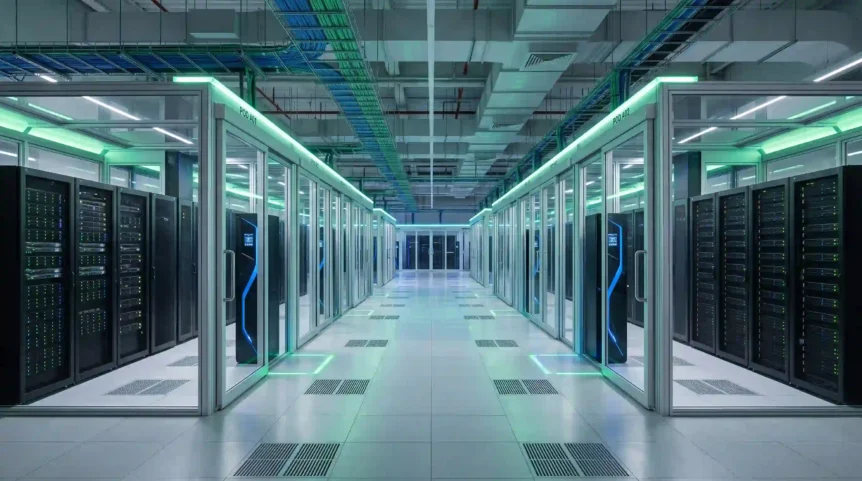
Rapid enterprise digitization, hyperscale cloud expansion, and explosive growth in generative AI models are placing unprecedented strain on legacy infrastructure. Modern facilities require a complete paradigm shift to maintain seamless performance, continuous uptime, and absolute operational efficiency under massive workloads.
Implementing comprehensive Data Center Solutions provides the structural foundation needed to meet these complex demands. By integrating next-generation architecture, businesses achieve the scalability and reliability required for compute-heavy applications.
The Evolving Landscape of Modern Data Center Solutions
Modern enterprise digitization and high-density computing demand flexible infrastructure capable of supporting hyper-scalable digital operations without sacrificing operational resilience.
Understanding Scope and Objectives
Comprehensive Data Center Solutions represent an integrated ecosystem of mission-critical power systems, precision cooling architectures, intelligent DCIM software, and scalable hardware design. These converged technologies work together to ensure maximum resource efficiency across physical environments.
Operators face the dual challenge of delivering 99.999% uptime for high-density workloads while adhering to strict regional environmental standards. This guide covers core infrastructure, management systems, AI adaptations, and regional compliance models.
Read Also: Double Conversion UPS: Guide to Online Power Backup
Core Infrastructure Components: Building Resilient and High-Performance Facilities
Robust infrastructure forms the bedrock of high-availability facilities, ensuring continuous power distribution and optimal thermal regulation.
1. Mission-Critical Power Management Architecture
Double-conversion online UPS systems, lithium-ion battery integration, and kinetic flywheels work together to smooth severe voltage fluctuations. Emergency standby diesel generators, quick-start fuel systems, and hydrogen fuel cells provide reliable, multi-layered backup power during primary grid outages.
Smart breaker panels, rack PDUs with branch circuit monitoring, and automatic transfer switches (ATS) ensure precise electricity distribution. These components enable granular load balancing, isolated fault protection, and automated failover mechanics across server racks.
Redundancy Configurations: N+1, 2N, and Beyond
Standard tier topologies like N+1 redundancy and 2N fault-tolerant architectures isolate operational risk during maintenance. Implementing multi-path power distribution guarantees zero service interruptions during component failures.
2. Advanced Precision Cooling & Thermal Management
Computer Room Air Conditioning (CRAC) and CRAH systems utilize variable speed fans with hot/cold aisle containment to eliminate thermal recirculation. High-density environments deploy direct-to-chip cold plates, single-phase immersion, and two-phase immersion cooling directly to compute nodes.
Machine learning algorithms continuously optimize fan speeds, chilled water supply temperatures, and air distribution patterns based on compute stress. This real-time thermal balancing drastically reduces cooling power consumption while preventing localized hardware hot spots.
Mitigating Thermal Throttling in High-Density AI Racks
Handling heat density exceeding 40kW to 100kW+ per rack requires hybrid liquid-to-air cooling strategies. High-flow coolant distribution units (CDUs) prevent hardware thermal throttling during sustained GPU processing spikes.
3. Modular and Prefabricated Deployment Models
Prefabricated Modular (PFM) infrastructure delivers factory-tested power and cooling skids that shorten site construction schedules by 50%. These off-site engineered solutions ensure strict quality control while minimizing on-site disruption.
Containerized pod-based architectures allow enterprise operators to expand compute capacity in standardized, repeatable blocks. This incremental scaling framework optimizes capital expenditure, reduces initial CapEx, and accelerates time-to-value.
Data Center Management, Intelligence, and Operational Optimization
Software intelligence and automated telemetry streamline facilities management, driving higher operational visibility and network stability.
1. Intelligent Data Center Infrastructure Management (DCIM)
Advanced DCIM software platforms deliver real-time telemetry across electrical distribution networks, dynamic Power Usage Effectiveness (PUE) metrics, and efficiency dashboards. These platforms aggregate facility data into actionable insight for continuous energy optimization.
Dense arrays of IoT sensors monitor ambient temperatures, humidity, airflow rates, and liquid leaks across the compute floor. Machine learning models analyze this telemetric data to perform predictive maintenance, detecting hardware wear before failure.
2. High-Speed Network Connectivity & Regional Redundancy
High-capacity Dense Wavelength Division Multiplexing (DWDM), dark fiber pipelines, and carrier-neutral cross-connects ensure ultra-low latency transfers. Direct access to subsea cable landing stations minimizes international network hop counts significantly.
These direct optical interconnects bypass public internet congestion points to maximize bandwidth efficiency. Modern data center solutions utilize these multi-path network connections to maintain continuous high-speed connectivity.
Dual-Site Redundancies: Case Study of Singapore’s Changi-to-West Connectivity
Singapore’s topology uses active-active dual-site connections between Changi and West regional hubs. This ultra-low-latency geographical route diversity enables real-time data replication and seamless failover.
Maintaining concurrent active connections between primary nodes mitigates localized disaster impacts on business operations. High-speed optical infrastructure ensures continuous availability across critical regional data pathways.
Sustainability, ESG Compliance, and Green Building Frameworks
Modern facilities prioritize energy management and sustainable engineering to lower carbon footprints and comply with local regulations.
1. Carbon Accounting, Scope 1-3 Emissions, and ESG Reporting
Automated software tools track direct Scope 1 fuel emissions, Scope 2 electricity purchases, and indirect Scope 3 supply chain footprints. These platforms generate compliant audit logs for GRI, SASB, and TCFD corporate ESG reporting frameworks.
Facilities integrate virtual power purchase agreements (VPPAs), on-site solar microgrids, and renewable grid matching. Combining clean power purchasing with low PUE hardware lowers overall operational carbon intensity.
2. Next-Generation Energy Recovery & Circular Thermal Networks
Liquid cooling heat-recovery systems capture waste warm water from server racks and redirect it to external processes. This recovered heat supplies municipal district heating networks, industrial facilities, and nearby commercial properties.
Operators deploy closed-loop dry coolers and evaporative cooling towers to lower Water Usage Effectiveness (WUE) metrics. Conserving industrial water supplies reduces local ecosystem disruption without sacrificing cooling performance.
Singapore’s Green Data Center Standard (SS 564) and BCA-IDA Green Mark
Singapore enforces strict standards via the BCA-IDA Green Mark Platinum certification and SS 564 guidelines. Facilities must achieve PUE targets of 1.3 or lower, even while running dense AI workloads in tropical climates.
Compliance requires rigorous energy audits, sustainable building materials, and optimized mechanical cooling systems throughout operations. Meeting these green benchmarks ensures long-term operational eligibility within environmentally regulated markets.
Selecting the Right Data Center Solution: Key Enterprise Evaluation Criteria
Selecting appropriate infrastructure requires evaluating workload densities, long-term operational expenses, and physical security standards.
1. Assessing Workload Requirements: AI Density vs. Standard Enterprise Applications
Calculating average power density per rack determines whether facilities need liquid cooling or traditional air management. High-density AI training clusters require specialized power distribution paths and enhanced network interconnects.
Standard enterprise workloads run effectively on lower-density air-cooled equipment. Matching rack capability to specific processing profiles prevents over-provisioning and reduces unnecessary operational costs.
2. Evaluating Total Cost of Ownership (TCO) & ROI Metrics
Evaluating Total Cost of Ownership (TCO) requires balancing upfront CapEx against long-term OpEx energy savings. High-efficiency power and cooling systems reduce ongoing utility costs throughout the equipment lifecycle.
Modular deployments allow companies to align capital investments directly with actual capacity growth. Strict Service Level Agreements (SLAs) safeguard business continuity and protect long-term revenue.
3. Security, Physical Compliance, and Disaster Recovery
Multi-layer security incorporates biometric access readers, mantrap vestibules, and continuous video surveillance. Strict operational adherence to SOC 2 Type II and ISO 27001 standards protects sensitive enterprise data.
Geographically isolated disaster recovery sites maintain synchronized system backups to prevent data loss. Comprehensive business continuity plans ensure rapid recovery from unexpected regional outages.