
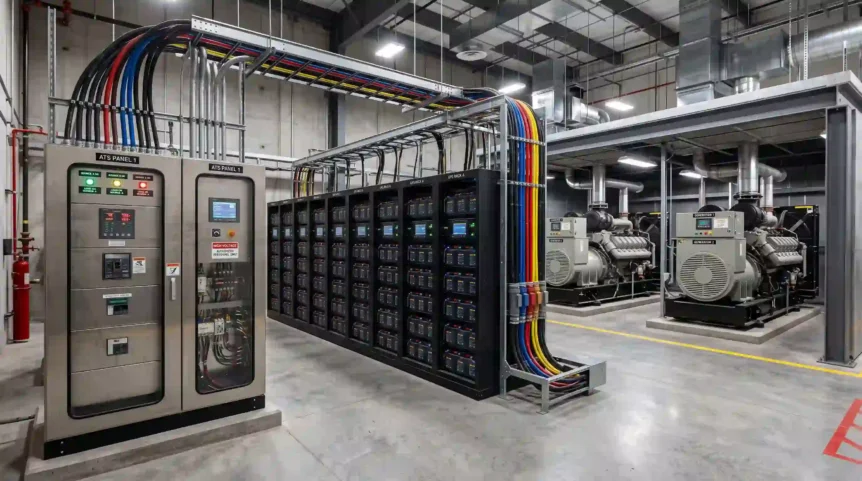
Modern business continuity relies heavily on an uninterrupted power supply to safeguard critical digital infrastructure. Integrating a ups generator setup creates a seamless defense mechanism against sudden grid failures and extended blackouts.
Without a cohesive backup power architecture, sudden outages risk catastrophic data loss and severe hardware corruption. By combining battery-based rapid response with internal combustion durability, organizations ensure complete operational continuity.
What is a UPS and How Does It Compare to a Generator?
Understanding energy storage versus energy production is vital for designing reliable backup architectures. While both systems protect against power interruptions, their underlying engineering serves entirely different functions.
Understanding the Role of an Uninterruptible Power Supply (UPS)
An uninterruptible power supply is a specialized battery system designed for continuous power monitoring. It instantly supplies stored direct current electricity through an inverter during sudden main grid drops.
This short-term power buffer shields delicate processing units from harmful electrical voltage sags and total power losses. It buys technical teams crucial time to initiate safe shutdowns or transition to secondary generation sources.
Read Also: Data Center Infrastructure: Architecture & Key Components
Understanding the Role of a Backup Generator
A backup generator is an engine-driven system that transforms mechanical combustion into stable alternating current electricity. Fueled by diesel, natural gas, or propane, it produces continuous electricity for extended periods during severe grid outages.
Unlike static battery banks, a mechanical generator requires several seconds to crank, stabilize, or transfer electrical load. It acts as the primary long-term power plant when utility grids suffer widespread or prolonged infrastructure failures.
Key Differences Between a UPS and a Generator
Choosing the correct backup hardware requires comparing response speeds, sustained runtime capabilities, and internal energy conversion mechanisms. Both technologies fulfill distinct yet highly complementary roles in modern emergency electrical setups.
1. Response Time: Instantaneous vs. Delayed Transfer
A battery-based ups generator pairing resolves the inherent latency gap found in standby diesel units. The internal static transfer switch of a UPS engages within milliseconds, completely eliminating momentary power micro-drops.
In contrast, an engine generator requires 10 to 30 seconds to start, adjust rotational speeds, and take over the load. Without battery buffering, connected IT hardware reboots before the generator can properly stabilize power delivery.
2. Runtime Capability: Minutes vs. Days
A standard UPS battery bank is engineered specifically for short-duration energy discharge, usually between 5 to 30 minutes. Its main objective is bridging initial utility outages rather than sustaining long-term facility operations.
Conversely, a mechanical standby generator provides continuous power for hours or days, limited only by available site fuel reserves. Continuous fuel replenishment allows complex commercial operations to run indefinitely during catastrophic grid shutdowns.
3. Power Source and Energy Conversion
A UPS relies on chemical energy stored within internal lithium-ion or lead-acid cell configurations. It converts silent direct current battery power into clean alternating current through solid-state power electronics.
Engine generators rely on internal combustion, burning fossil fuels to rotate electromagnetic alternators that yield high-capacity AC electricity. This dynamic mechanical process generates noise, exhaust emissions, and mechanical friction requiring regular maintenance.
How a UPS and Generator Work Together as a Hybrid Solution
Combining static batteries with combustion engines establishes an ideal, redundancy-focused hybrid architecture. This integrated approach ensures both immediate protection and long-term facility endurance without operational interruptions.
1. The Bridge Concept: Eliminating the Power Gap
During an outage, the UPS instantly supports connected workloads without a single microsecond of power interruption. Concurrently, an automatic transfer switch signals the emergency generator engine to start up and ramp speed.
Once the generator stabilizes its output, the transfer switch safely routes the raw generator output to the UPS input. The UPS seamlessly transitions from battery discharge mode back to utility-style operation, keeping the facility fully powered.
2. Power Conditioning: Cleaning Raw Generator Energy
Emergency engine alternators frequently produce unstable voltage spikes, raw harmonic distortions, and noticeable frequency fluctuations. Sensitive enterprise servers and medical electronics can easily malfunction when exposed to such unconditioned generator power.
The inline UPS acts as an active electronic filter, conditioning dirty mechanical generator energy before passing it downstream. It guarantees connected mission-critical hardware receives steady, purified sinusoidal electrical waves at all times.
3. Why Double-Conversion Online UPS is the Best Match for Generators
An online double-conversion UPS offers complete isolation by perpetually converting incoming AC to DC, then reconstructing pristine AC output. This continuous process neutralizes severe frequency drift and voltage spikes originating from engine alternators.
Consequently, double-conversion topologies prevent connected IT gear from detecting generator output instability. This continuous isolation guarantees stable operational continuity regardless of load variations or engine speed fluctuations.
Key Benefits of Integrating a UPS Generator System
Deploying a combined ups generator setup yields significant operational resilience while safeguarding expensive technical investments. This unified strategy minimizes costly operational disruptions across commercial, industrial, and healthcare environments.
1. Zero Downtime for Sensitive Electronics
Instantaneous battery transfer completely eliminates operational downtime for high-density data centers and specialized laboratory devices. Critical network routers, storage arrays, and medical monitors remain continuously energized without dangerous system reboots.
Preventing unexpected crashes stops corrupted database files, lost transactions, and expensive equipment recovery procedures. Operations remain entirely smooth regardless of severe environmental or grid conditions outside.
2. Extended Operational Continuity
Integrating long-term fuel power with instant battery bridging ensures business operations never stall during major disaster events. Facilities can comfortably maintain full productivity throughout severe, multi-day blackout situations seamlessly.
This reliable continuous power protection shields commercial enterprises from massive financial revenue losses during local power crises. It transforms vulnerable digital infrastructure into an exceptionally resilient asset capable of continuous productivity.
3. Equipment Lifespan Protection
Raw electrical surges, frequency wander, and voltage sags impose severe thermal stress on sensitive electronic power supplies. The active voltage regulation provided by an inline UPS eliminates harmful electrical noise entirely.
By shielding delicate microprocessors from raw generator output, hardware components suffer less degradation over time. This continuous power conditioning significantly extends overall equipment service life and lowers maintenance costs.
Common Challenges and Compatibility Issues to Consider
Proper engineering and system integration are critical when combining engine alternators with static UPS equipment. Miscalculating electrical tolerances often leads to system hunting, battery failure, or complete load dropping.
1. Generator Sizing and Slew Rate Compatibility
A standby engine generator must be sized 1.5x to 2x larger than the overall UPS electrical load. This extra capacity handles high initial step-loads and absorbs harmonic distortions generated by rectifier circuits.
Improperly sized generators struggle with sudden load transfers, causing internal engine stalling or severe output voltage drops. Sizing the alternator generously prevents system instability when the UPS transfers back to generator power.
2. Frequency Tolerance and Governor Types
Mechanical engine governors often respond slowly to sudden load changes, causing wide output frequency deviations. When frequency strays outside acceptable ranges, a UPS will reject the generator input and remain on battery.
Utilizing precise electronic governors ensures fast, tight frequency regulation matching exact UPS input windows. This tight synchronization prevents battery exhaustion by allowing the UPS to comfortably accept generator power.