
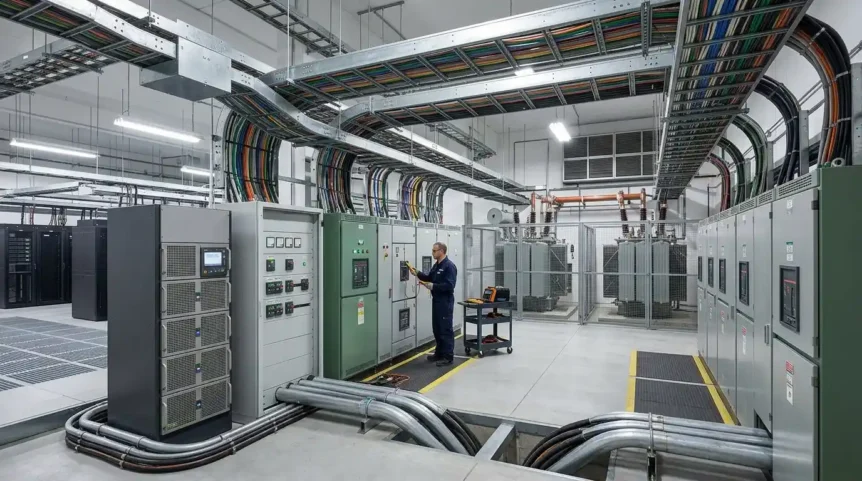
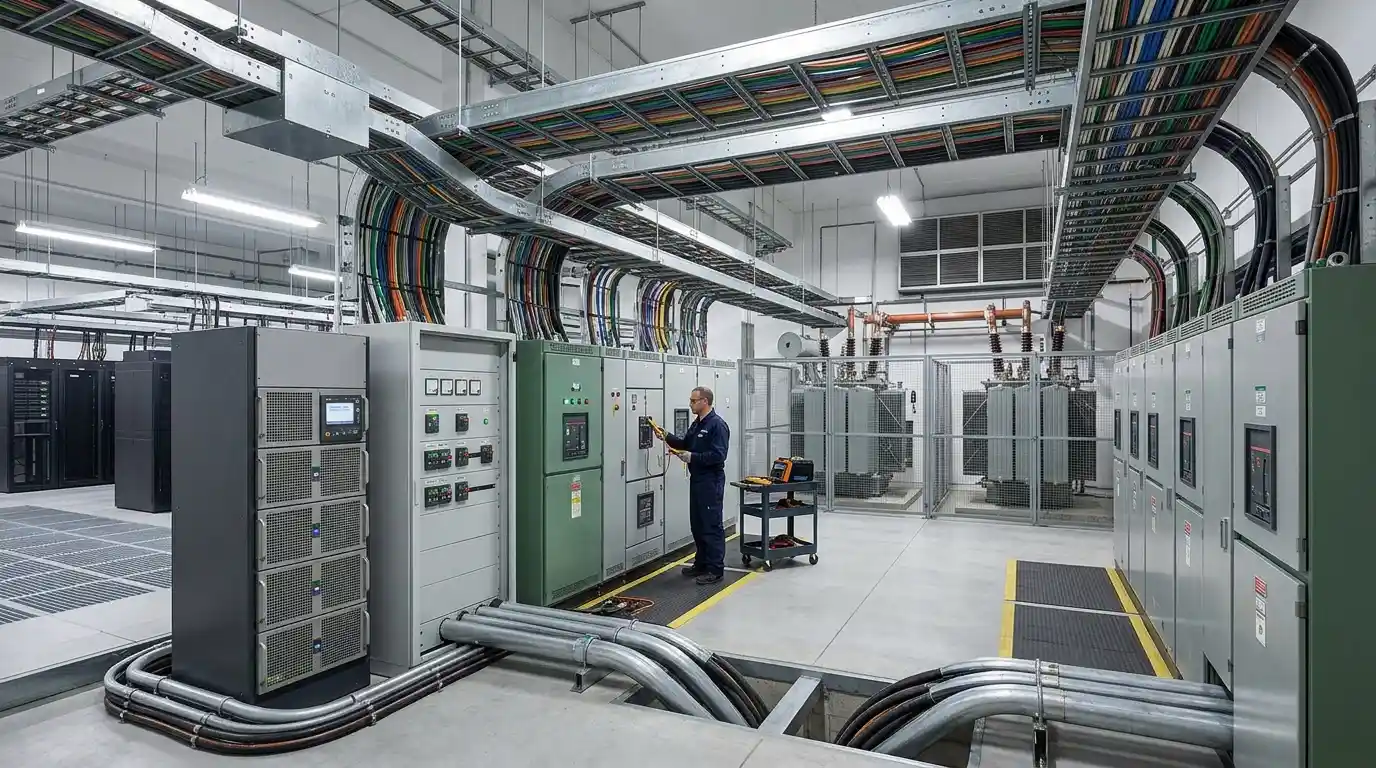
A single power failure can disrupt critical applications, compromise operations, and cause costly downtime. That makes data center electrical infrastructure the foundation of reliable, resilient, and continuously available digital services.
From utility power and UPS systems to generators, switchgear, and distribution equipment, every component must work together seamlessly. Understanding their roles, design principles, and best practices is essential for modern data centers.
Key Takeaways:
- Data center electrical infrastructure integrates power supply, backup systems, distribution, protection, and monitoring to maintain continuous operations.
- UPS systems provide immediate power continuity, while generators deliver longer-duration backup during utility failures.
- N+1, 2N, and 2N+1 redundancy architectures reduce dependency on individual components and support electrical resilience.
- Effective design balances power capacity, density, efficiency, scalability, fault protection, maintainability, and power quality.
- Intelligent monitoring improves visibility into electrical performance, capacity, faults, and operational trends across the facility.
What Is Data Center Electrical Infrastructure?
A reliable data center electrical infrastructure connects utility power, backup systems, distribution equipment, protection devices, and monitoring technologies into an integrated architecture designed for continuous digital operations and resilience.
Data center electrical infrastructure is the interconnected system responsible for receiving, converting, distributing, protecting, and monitoring electrical power required by critical IT equipment and supporting facility systems.
Its primary purpose is to maintain continuous power availability while managing reliability, resilience, safety, efficiency, and scalability. Unlike conventional buildings, data centers must support highly sensitive loads operating continuously.
Read Also: Power Distribution Centers: Types, Components & Uses
Key Components of Data Center Electrical Infrastructure
Each electrical component performs a specific function within the overall data center power infrastructure. Together, these systems create controlled power paths that support reliability, maintainability, capacity, and operational continuity.
1. Utility Power Supply
Utility power supply forms the normal source for most data centers, delivering electricity from the grid into the facility through carefully engineered incoming service and electrical distribution systems and equipment.
Utility power provides the primary electrical supply entering a data center from the local grid. Incoming service typically passes through transformers, switchgear, and protection equipment before reaching downstream distribution systems.
Incoming electrical infrastructure must accommodate present demand while allowing capacity expansion. Proper service sizing, protection coordination, and interconnection planning help operators manage growing loads and reduce constraints during future deployments.
2. Backup Generators
Backup generators provide an independent power source when normal utility service fails, supporting critical loads while electrical operators restore grid availability or maintain facility operations during extended power interruptions.
During an outage, generators must start reliably, reach stable operating conditions, and support designated loads until utility service returns. Fuel availability, testing, maintenance, and load-bank verification are therefore important considerations.
3. Uninterruptible Power Supply (UPS)
Uninterruptible power supply (UPS) systems protect critical loads from electrical disturbances by providing immediate backup power and maintaining stable voltage while longer-duration generation systems become available during extended power outages.
UPS systems differ from generators because they respond immediately and protect sensitive IT equipment from power disturbances. Generators provide longer-duration backup, while UPS systems deliver ride-through capability and power conditioning.
4. Power Distribution Units (PDUs)
Power distribution units (PDUs) form the final distribution stage between upstream electrical infrastructure and IT equipment, delivering controlled power to racks while enabling circuit protection, measurement, and capacity management.
Modern data centers may use intelligent PDUs that provide branch-circuit monitoring and remote visibility. These capabilities help operators understand rack-level consumption, identify abnormal conditions, and manage available electrical capacity.
5. Switchgear and Switchboards
Switchgear and switchboards control, protect, and isolate electrical circuits throughout a data center. Their configuration supports safe switching, fault management, maintenance, and dependable distribution across critical power paths.
Effective protection requires coordinated electrical devices that isolate faults without unnecessarily disconnecting healthy portions of the system. Proper coordination improves selectivity, supports maintenance activities, and protects critical infrastructure from electrical disturbances.
6. Busway and Busbar Systems
Busway and busbar systems provide modular methods for distributing electrical power across data center spaces. Their architecture can simplify capacity changes and support flexible rack connections as computing requirements evolve.
High-density data centers increasingly require power distribution architectures capable of delivering substantial current within constrained spaces. Busway systems can support scalable rack connections while reducing physical limitations associated with conventional cable distribution.
7. Power Monitoring Systems
Power monitoring systems provide continuous visibility into electrical performance by measuring key parameters across the facility. This information supports capacity planning, fault detection, efficiency improvements, and informed operational decisions.
Monitoring platforms can integrate electrical measurements with data center infrastructure management (DCIM) and building management systems (BMS). This integration enables centralized visibility, alarms, trend analysis, and more informed capacity decisions.
How Does Data Center Electrical Infrastructure Work?
A data center electrical infrastructure operates through coordinated power paths that deliver electricity from the utility source to critical IT equipment, while maintaining continuity through backup systems and automatic switching.
1. Primary Power Path
The primary power path carries electricity from the utility grid through incoming service equipment, switchgear, transformers, and distribution systems before reaching UPS equipment and downstream IT loads.
Under normal conditions, utility power supplies the facility continuously. Electrical protection, monitoring, and distribution equipment regulate this path, helping maintain appropriate voltage, frequency, and power quality for critical operations.
2. Backup Power Path
The backup power path provides an alternative electricity source when the primary utility supply becomes unavailable. It commonly combines UPS systems, standby generators, automatic transfer equipment, and redundant distribution paths.
UPS systems provide immediate power continuity while generators start and stabilize. Once generators become available, they can support designated loads for extended periods, depending on fuel capacity and operational requirements.
3. Automatic Transfer During Power Failures
Automatic transfer systems detect utility interruptions and initiate predefined switching sequences, transferring electrical loads toward available backup sources. This process reduces manual intervention and helps maintain continuity for critical data center operations.
The transition between power sources requires coordinated controls, protection settings, and equipment sequencing. Properly engineered transfer systems help prevent unnecessary interruptions while ensuring backup generators and distribution equipment operate safely.
4. Electrical Power Flow From Utility to IT Equipment
Understanding the complete electrical power flow helps operators identify dependencies, protection points, and potential single points of failure throughout the facility’s electrical architecture and distribution chain.
From incoming utility power to rack-level distribution, each component contributes to delivering stable electricity. Monitoring and protection systems provide additional visibility and safeguards across this critical power delivery chain.
Data Center Electrical Infrastructure Redundancy
Electrical redundancy ensures that critical power systems can continue operating when individual components fail, require maintenance, or become unavailable, reducing dependency on any single electrical component or pathway.
1. N+1 Redundancy
N+1 redundancy provides one additional component beyond the minimum number required to support the intended load. If one component fails, the remaining capacity can continue supporting operations.
For example, a system requiring four UPS modules could use five modules under an N+1 architecture. This configuration provides additional capacity for component failure or maintenance without necessarily disrupting critical loads.
2. 2N Redundancy
2N redundancy provides two independent systems, with each system capable of supporting the complete critical load independently. This architecture creates separate power paths and reduces dependency on individual infrastructure components.
A 2N configuration can allow maintenance or failure within one power path while another continues serving the load. Its implementation generally requires additional equipment, space, distribution infrastructure, and operational coordination.
3. 2N+1 Redundancy
2N+1 redundancy combines two fully independent power systems with additional capacity beyond each complete system’s required load. This architecture provides greater tolerance for component failures and maintenance scenarios.
The appropriate redundancy strategy depends on factors including availability requirements, operational risk, facility design, maintenance procedures, and infrastructure constraints. Higher redundancy can increase resilience, but also introduces greater complexity and capital requirements.
Data Center Electrical Infrastructure Design Considerations
Designing data center electrical infrastructure requires balancing capacity, reliability, efficiency, scalability, protection, maintainability, and power quality. These factors must be evaluated together because electrical decisions directly influence facility performance and operational resilience.
1. Power Capacity and Load Calculation
Accurate power capacity planning establishes how much electrical infrastructure a data center needs under current and future operating conditions, including IT loads, cooling systems, auxiliary equipment, and expansion requirements.
Engineers should evaluate peak, average, and future loads rather than sizing systems only around initial demand. Proper calculations help prevent undersizing while avoiding excessive infrastructure that increases capital expenditure and operating losses.
2. Power Density
Power density describes the electrical demand concentrated within a defined data center area, rack, or computing environment. Increasing density can significantly affect power distribution, cooling requirements, equipment selection, and facility planning.
AI and high-performance computing can create substantially higher rack power densities, requiring electrical systems capable of delivering greater power within limited physical spaces. Designers therefore need coordinated electrical and thermal strategies.
3. Electrical Efficiency
Electrical efficiency focuses on minimizing losses throughout the power chain, from utility service and transformers to UPS systems, distribution equipment, and final IT loads, without compromising required availability.
Efficient equipment selection and appropriate operating conditions can reduce electrical losses and associated heat generation. Effective design should therefore consider equipment efficiency across different load conditions rather than evaluating components independently.
4. Scalability
Electrical scalability enables infrastructure to accommodate increasing IT demand without requiring disruptive redesigns or premature replacement of major power equipment, making future capacity planning an important design consideration.
Modular distribution systems, phased capacity additions, and flexible power architectures can support future expansion more effectively. This approach becomes increasingly important as AI workloads and data center electricity requirements continue growing.
5. Fault Protection
Fault protection safeguards electrical infrastructure against short circuits, overloads, equipment failures, and other abnormal conditions. Protection systems should isolate affected sections while preserving power to unaffected critical loads whenever possible.
Proper overcurrent protection selectivity helps prevent a localized electrical fault from unnecessarily disconnecting larger portions of the facility. Protection coordination therefore supports both equipment safety and overall data center resilience.
6. Maintainability
Maintainability ensures electrical equipment can be inspected, tested, repaired, or replaced while minimizing disruption to critical operations. Data center designs should therefore incorporate maintenance procedures directly into their power architecture.
Redundant power paths, accessible equipment, appropriate isolation capabilities, and structured maintenance procedures can support planned work without unnecessarily interrupting critical loads. These considerations should be validated through commissioning and operational testing.
7. Power Quality
Power quality refers to the characteristics of electrical supply that affect the reliable operation of sensitive equipment, including voltage stability, frequency behavior, harmonics, transients, and other electrical disturbances.
Modern data centers increasingly rely on power electronics such as UPS systems and power-factor-corrected equipment. Their behavior can influence electrical performance, making power-quality analysis important during design and grid-interconnection studies.
References:
- American Society of Heating, Refrigerating and Air-Conditioning Engineers. (2023). ASHRAE handbook—HVAC applications: Data centers and telecommunication facilities. ASHRAE Handbook.
- American Society of Heating, Refrigerating and Air-Conditioning Engineers. (2026). AI data center energy performance framework. ASHRAE AI Data Center Energy Performance Framework.
- Lawrence Berkeley National Laboratory. (2026). Center of expertise for data center energy. U.S. Department of Energy. LBNL Data Center Energy Center of Expertise.