
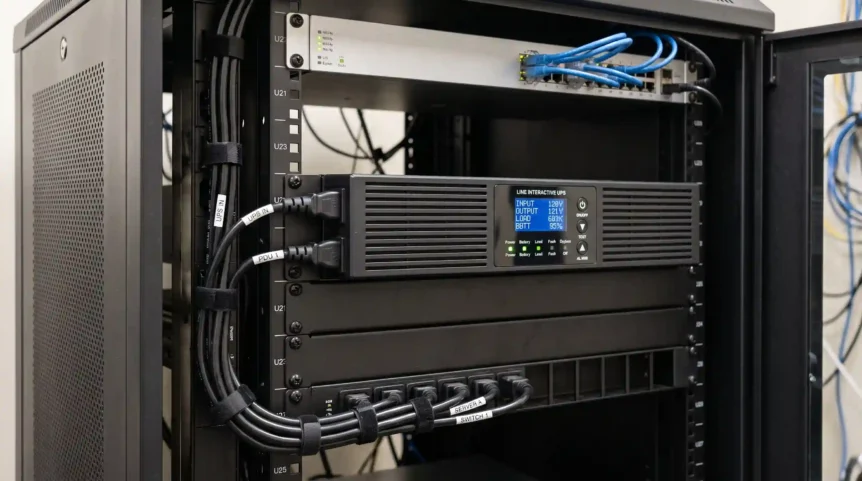
Power sags and surges may seem harmless, but these invisible electrical disturbances can silently damage sensitive electronics, shorten hardware lifespan, and cause unexpected data loss. Modern devices require more than basic protection against sudden power failures.
A Line-Interactive UPS is a power protection system that regulates voltage fluctuations while providing battery backup during outages. Offering a balance between cost and performance, it has become the ultimate choice for reliable protection in homes and offices.
What is a Line-Interactive UPS?
A Line-Interactive UPS is a power protection device that provides continuous electricity, voltage regulation, and battery backup during power interruptions. It offers a balanced approach between basic standby systems and advanced online UPS solutions.
Positioned between a Standby UPS system and a Double-Conversion Online UPS, a Line-Interactive UPS topology uses an automatic voltage regulator (AVR) to correct minor voltage fluctuations without immediately switching to battery power.
How Does a Line-Interactive UPS Work?
A line-interactive UPS system operates through continuous voltage regulation, battery management, and power conversion mechanisms designed to protect sensitive equipment. This architecture provides efficient backup power while correcting common AC power disturbances.
1. Normal Operation Mode
During normal operation, a line-interactive UPS receives electricity directly from the utility AC power source while actively analyzing voltage fluctuations. The system uses power conditioning technology to stabilize irregular electrical input before reaching connected devices.
The integrated automatic voltage regulator (AVR) increases or decreases voltage levels without switching to battery mode. This process protects computers, servers, and networking hardware from brownouts, overvoltage conditions, and minor power quality issues.
Read Also: UPS Generator Systems: Complete Power Protection Guide
2. The Role of the Inverter
The inverter represents a critical component within a line-interactive UPS topology because it performs bidirectional power conversion. During standard operation, it converts incoming AC electricity into DC energy to maintain battery charging efficiency.
When electrical interruptions occur, the inverter changes direction and converts stored DC battery energy into stable AC output power. This seamless conversion process enables continuous operation for protected equipment without significant downtime.
3. Battery Power Mode
When the utility supply fails completely, a line-interactive UPS immediately enters battery backup mode. The inverter automatically reverses operation, transforming stored battery energy into regulated AC electricity for connected devices.
This rapid transition protects critical electronics from power interruptions, voltage instability, and potential data loss. Modern systems achieve near-instantaneous transfer times suitable for workstations, network devices, and small server environments.
Why Choose Line-Interactive UPS?
Choosing a line-interactive UPS system provides an effective balance between cost efficiency, power protection, and operational reliability. This technology delivers advanced power management capabilities without the higher investment required by online double-conversion UPS systems.
1. Automatic Voltage Regulation (AVR)
The primary advantage of a line-interactive UPS is its built-in automatic voltage regulation (AVR) capability. AVR continuously adjusts incoming electrical voltage to maintain stable output levels while reducing unnecessary battery cycling during common power fluctuations.
Unlike traditional backup systems that immediately rely on batteries, AVR technology uses transformer-based correction methods to regulate voltage conditions. This improves battery lifespan, enhances efficiency, and provides cleaner power delivery for connected equipment.
2. Buck Mode: Trimming Down High Voltage Spikes
Buck mode is an AVR function designed to reduce excessive incoming voltage without activating the battery system. When electrical input exceeds safe operating limits, the UPS lowers the voltage level through voltage attenuation technology.
This process protects sensitive electronics from voltage surges, temporary overvoltage events, and unstable utility conditions. By correcting high voltage fluctuations automatically, the UPS maintains reliable power output while preserving battery capacity for actual outages.
3. Boost Mode: Stepping Up Low Voltages (Brownouts) Without Draining the Battery
Boost mode operates as the opposite of buck mode by increasing insufficient voltage levels caused by brownout conditions. The UPS raises low AC voltage through AVR circuits without switching to battery operation.
This feature prevents unnecessary battery discharge during extended periods of reduced voltage. As a result, line-interactive UPS devices maintain continuous protection while maximizing battery backup availability during critical power failures.
4. Transfer Time: The 2-8 Millisecond Window That Keeps Electronic Components Running Without a Reboot
A line-interactive UPS transfer time refers to the brief interval required to switch from utility power to battery power during an outage. Most systems complete this transition within approximately 2 to 8 milliseconds.
This rapid switching capability allows computers, networking equipment, and peripheral devices to continue operating without interruption. Properly designed power supply units (PSUs) can tolerate this short delay while preventing system crashes or unexpected shutdowns.
5. Waveform Output Options
Another important consideration when selecting a line-interactive UPS is its output waveform technology. The waveform determines how smoothly electrical power is delivered to connected devices, especially equipment with advanced power conversion systems.
Modern UPS products commonly provide either simulated sine wave or pure sine wave output. The correct choice depends on equipment sensitivity, power supply design, and application requirements.
6. Simulated Sine Wave: Budget-Friendly
Simulated sine wave output is a cost-effective waveform option commonly found in entry-level line-interactive UPS models. It approximates traditional AC electricity using stepped voltage patterns rather than a perfectly smooth waveform.
This technology works effectively for standard computers, routers, and basic office electronics. However, devices using complex power circuits may experience compatibility issues, including audible noise, reduced efficiency, or operational instability.
7. Pure Sine Wave: Essential for Sensitive AV Equipment and Active PFC Power Supplies
Pure sine wave output produces electricity that closely matches utility-grade AC power, making it ideal for sensitive electronics. Equipment featuring active power factor correction (Active PFC) requires cleaner waveform quality for optimal operation.
High-performance devices such as gaming computers, professional audio systems, medical electronics, and advanced networking hardware benefit from pure sine wave UPS technology. This waveform minimizes compatibility risks while ensuring stable performance during battery operation.
Line-Interactive vs. Standby vs. Online UPS
Understanding the differences between line-interactive UPS, standby UPS, and online double-conversion UPS helps businesses select suitable power protection solutions. Each topology provides different levels of voltage regulation, efficiency, and outage response capabilities.
1. Line-Interactive vs. Standby (Offline)
Compared with a standby UPS system, a line-interactive UPS offers superior voltage control through integrated automatic voltage regulation (AVR) technology. This allows the system to correct minor voltage abnormalities without switching to battery power.
A standby UPS only activates battery backup when utility power fails, making it more dependent on frequent battery transitions. Meanwhile, line-interactive topology reduces unnecessary battery cycling, extending battery service life and improving long-term reliability.
The improved power conditioning capability of line-interactive systems makes them better suited for environments experiencing frequent brownouts, voltage sags, or unstable electrical supply. Standby models remain practical for basic devices such as home computers, routers, and consumer electronics.
2. Line-Interactive vs. Online (Double-Conversion)
Compared with an online double-conversion UPS, a line-interactive UPS provides greater energy efficiency because it does not continuously convert incoming AC power into DC and back into AC during normal operation.
This simplified architecture reduces energy losses, minimizes thermal output, and lowers operational expenses. For small offices, network equipment, and edge computing applications, line-interactive systems provide reliable protection without the higher installation and maintenance costs of online UPS technology.
An online UPS system delivers the highest level of power protection by isolating equipment from utility fluctuations through continuous conversion. However, this constant processing increases electricity consumption, heat generation, and cooling requirements.