
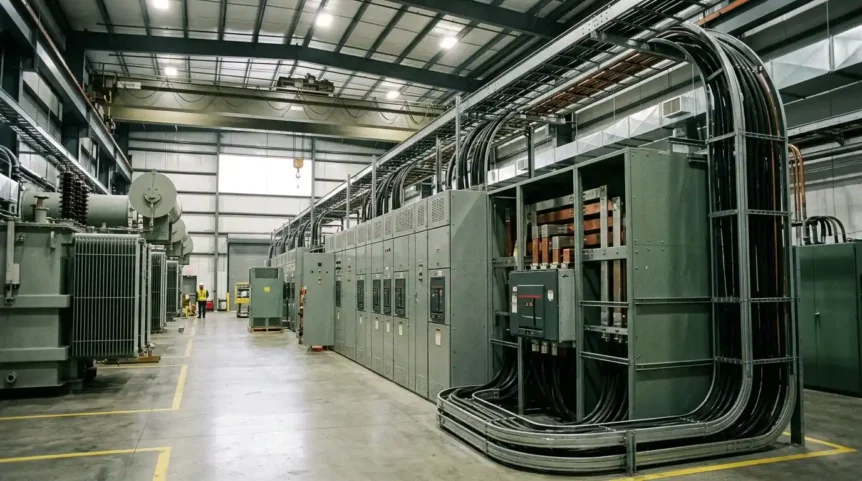
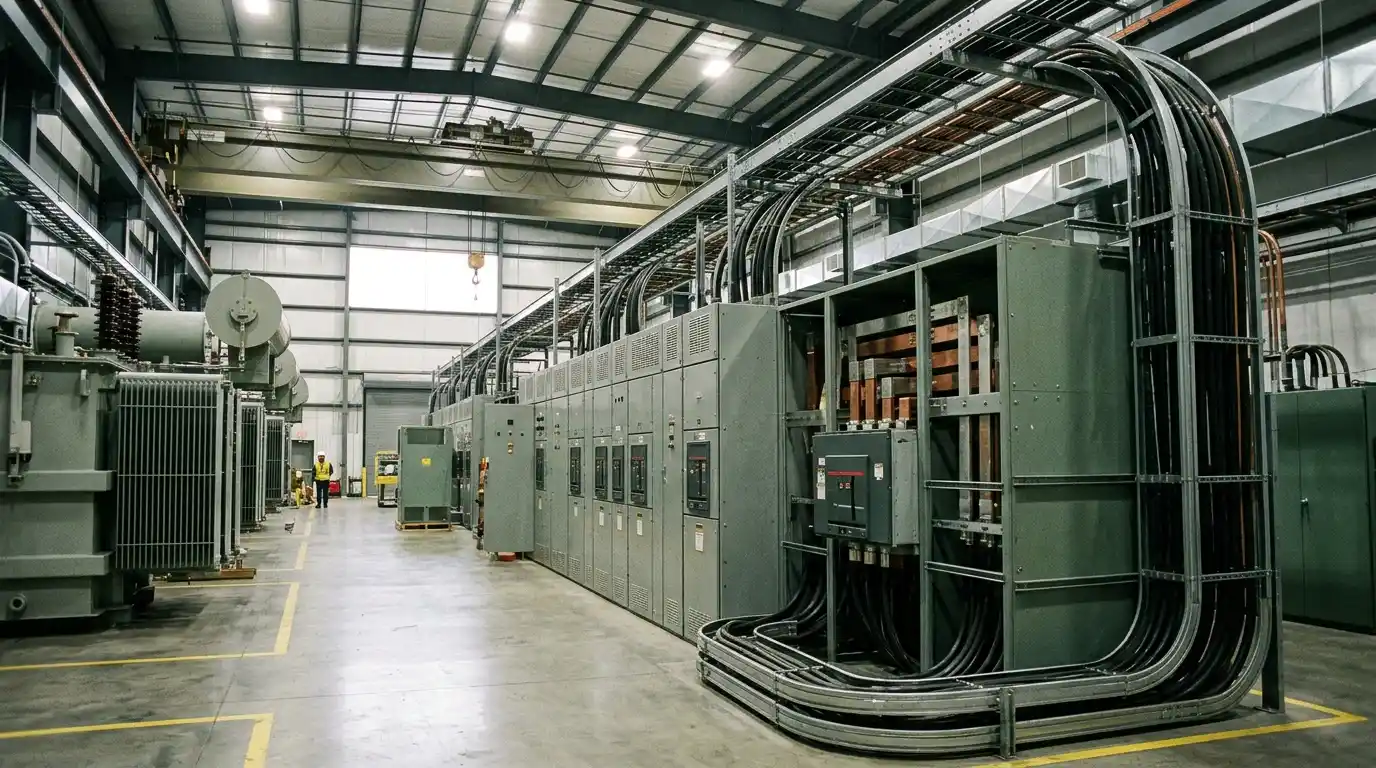
A single minute of power instability can disrupt production, damage equipment, and generate substantial downtime costs for industrial facilities. Reliable electricity management is therefore essential for maintaining continuous, predictable manufacturing operations.
Industrial power distribution solutions are engineered systems designed to safely manage and route high-capacity electricity throughout factories, plants, and heavy-duty facilities. This guide explores resilient, scalable, and safe industrial electrical infrastructure.
Key Takeaways:
- Industrial power distribution solutions manage high-capacity electricity while supporting safe, reliable, and scalable manufacturing operations.
- High loads, power quality problems, and harsh environments require careful electrical infrastructure planning and equipment protection.
- Substations, transformers, switchgear, MCCs, and busway systems form the foundation of modern industrial power distribution.
- Smart monitoring, PFC, and arc flash mitigation improve energy efficiency, system visibility, and electrical safety.
- Combining UPS systems with backup generators creates layered power resilience for mission-critical industrial operations.
Key Challenges in Industrial Power Distribution
Modern industrial power distribution systems must handle demanding electrical loads while maintaining stable, safe, and continuous operation. Manufacturing facilities require infrastructure capable of supporting production equipment under complex operating conditions.
1. High Load Demands
Industrial facilities can place substantial continuous demands on electrical distribution equipment through heavy machinery, furnaces, motors, compressors, and automated production lines. Proper capacity planning is essential to prevent excessive loading and interruptions.
Large industrial electrical loads can also create significant voltage drops and thermal stress when equipment operates simultaneously. Engineers must evaluate demand profiles, starting currents, transformer capacity, and feeder ratings when designing scalable distribution infrastructure.
Read Also: Electrical Power Distribution for Smart & Secure Solution
2. Power Quality Issues
Power quality problems such as voltage sags, surges, harmonics, and frequency disturbances can interfere with industrial equipment and production processes. Even brief voltage disturbances may affect motors, robotics, machine tools, and automated controls.
Nonlinear equipment and power electronics can generate harmonic distortion, increasing electrical losses and potentially creating overheating or equipment-performance problems. Monitoring, filtering, voltage regulation, and appropriate power-factor correction can improve overall power quality.
3. Harsh Environments
Industrial electrical equipment may operate around dust, moisture, oil, chemicals, vibration, and extreme temperatures. Without suitable protection, environmental contaminants can enter electrical enclosures, accelerate deterioration, and compromise equipment reliability or safety.
Selecting appropriate electrical enclosures is therefore essential for harsh industrial environments. NEMA enclosure classifications specify protection against conditions including dust, water, oil, and corrosive agents, depending on the application and installation location.
Essential Components of a Modern Industrial Power System
A modern industrial power system integrates equipment that transforms, distributes, controls, and protects electricity throughout a facility. These components must work together to support reliability, safety, scalability, and efficient plant operations.
1. Industrial Substations & Transformers
Industrial substations receive high-voltage utility power and use transformers to reduce voltage to levels suitable for plant distribution. This transformation enables electrical equipment to operate safely while supporting different voltage requirements throughout industrial facilities.
Depending on facility requirements, dry-type transformers or liquid-immersed units may be selected based on capacity, environment, efficiency, and installation conditions. Transformer selection also affects energy performance and the overall reliability of plant-level electrical infrastructure.
2. Switchgear and Switchboards
Switchgear and switchboards provide centralized control and protection for industrial electrical distribution, allowing operators to connect, disconnect, isolate, and protect circuits during normal operation or electrical faults. These assemblies are fundamental to safe power management.
Protective devices within switchgear systems can interrupt fault currents and isolate affected sections, helping limit equipment damage and maintain service to unaffected loads. Proper ratings, coordination, and installation are essential for reliable industrial power distribution.
3. Motor Control Centers (MCCs)
Motor control centers (MCCs) centralize equipment used to control and protect multiple motors, combining motor starters, circuit protection, control devices, and other components within an organized assembly. This arrangement supports efficient plant motor management.
Modern MCC systems can incorporate adjustable-speed drives, programmable controllers, protective relays, and feeder equipment. These integrated capabilities help facilities manage motor operation while supporting electrical safety, automation, maintenance, and operational visibility.
4. Busway and Busduct Systems
Busway and busduct systems use enclosed busbars to distribute electrical power, providing an alternative to extensive cable-and-conduit installations. Their modular construction can simplify power routing and support changes within evolving industrial facilities.
Compared with fixed cabling, modular busbar distribution can offer flexible connection points and organized power distribution across production areas. Proper system selection must consider current ratings, fault withstand capability, environmental conditions, and installation requirements.
Innovative Solutions for Optimization and Safety
Modern industrial power systems increasingly rely on intelligent technologies and advanced protection methods to improve efficiency, reliability, and operational safety. These solutions help facilities monitor performance, reduce risks, and optimize energy usage.
1. Smart Power Monitoring Systems (SCADA / IoT)
Smart power monitoring systems use technologies such as SCADA, IoT sensors, and advanced meters to collect real-time electrical data. These platforms allow operators to analyze energy consumption, identify abnormalities, and improve system visibility.
Through continuous monitoring of voltage levels, current flow, equipment conditions, and energy patterns, facilities can detect potential failures before major disruptions occur. This approach supports predictive maintenance and improves overall industrial power management.
2. Power Factor Correction (PFC)
Power factor correction (PFC) improves electrical efficiency by reducing reactive power demand within industrial facilities. Poor power factor can increase current requirements, create additional losses, and potentially result in utility penalties.
Facilities commonly install capacitor banks to compensate for reactive power generated by motors, transformers, and other inductive equipment. Proper PFC implementation can improve system efficiency, increase available capacity, and reduce unnecessary electrical consumption.
3. Arc Flash Mitigation
Arc flash mitigation focuses on reducing hazards caused by sudden electrical energy releases that can create extreme temperatures, pressure waves, and dangerous workplace conditions. Proper protection requires engineering controls, safety procedures, and equipment coordination.
Advanced protective relays, current-limiting devices, equipment designs, and arc-resistant switchgear can help reduce incident energy exposure. Conducting arc flash studies allows facilities to establish safer working distances and appropriate protective measures.
4. Redundant Power Systems
Redundant power systems combine multiple backup technologies to maintain electricity availability during failures or maintenance events. Industrial facilities often integrate uninterruptible power supplies (UPS) and backup generators for continuous operations.
A layered power resilience strategy allows UPS systems to provide immediate protection while generators supply extended backup energy. This configuration supports mission-critical operations where downtime can cause significant production losses or safety concerns.
References:
- National Institute of Standards and Technology. (2025). Spectrum tracking in power grid systems. U.S. Department of Commerce.
- National Institute of Standards and Technology. (2025). Measurement support for the U.S. electric-power industry in the era of deregulation, with focus on electrical measurements for transmission and distribution. U.S. Department of Commerce.
- National Electrical Manufacturers Association. (2018). NEMA 250-2018: Enclosures for electrical equipment (1000 volts maximum). NEMA.